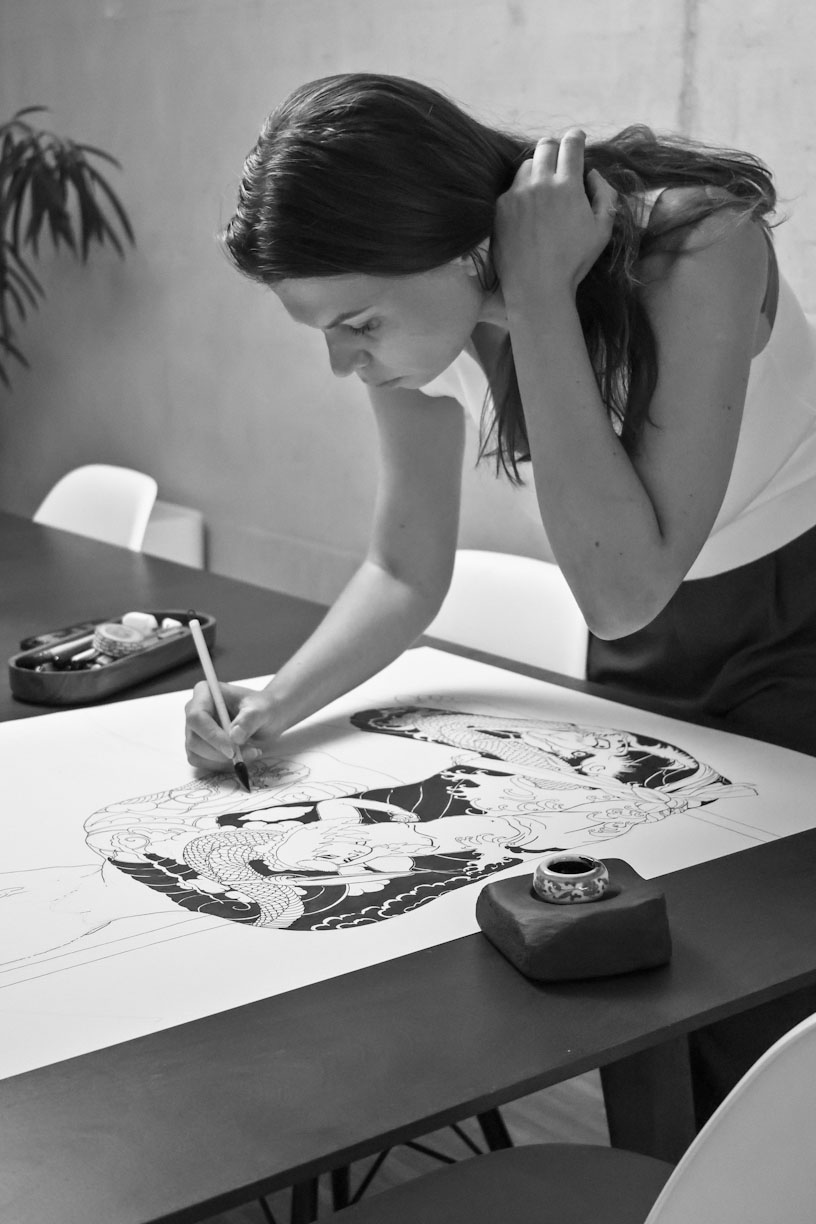
The release of three Fine Art prints, based on illustrations inspired by Akimitsu Takagi’s photographs, gives us the opportunity to meet Anna Badina. Based in Switzerland and originally from Russia, the artist reflects on her relationship with Japan, as well as her passion for tattoo culture and horimono, whose influence runs deep through her visual world.

Can you tell me about your background?
I am an illustrator and graphic designer based in Biel, Switzerland. My work sits at the intersection of hand drawing and graphic design. What defines me is a deep conviction: in a world saturated with digital tools, asserting the manual gesture, permanent ink, and the imperfection of the line is a way of remaining deeply human in one’s practice. The Japanese have a word for this, shokunin – the artisan who devotes themselves entirely to their craft, not for performance, but for integrity. It is toward this ideal that I strive.
Where does your connection to Japan come from, and how have you nurtured it?
It’s a relationship that has been built in layers, like ink slowly soaking into paper. Japanese aesthetics – the use of empty space as a language, the precision of the line, the beauty of impermanence – resonate deeply with the way I work. There is a notion in Japanese culture that I’m particularly drawn to: that interval, that silence between forms, which is not an absence but a presence in its own right. That is exactly what I seek in my drawings. This connection truly deepened through a project involving Washi paper from Gifu Prefecture, where I was able to explore these forms of craftsmanship in depth. Since paper is my primary tool in illustration, it felt like an obvious, almost necessary encounter.
”Asserting the manual gesture, permanent ink, and the imperfection of the line is a way of remaining deeply human in one’s practice.


How did you become interested in tattooing?
Tattooing resonates with me for the same reasons that drive my work: it is an image carried on the skin – permanent, irreversible. In the Japanese tradition, irezumi (Japanese tattoing) is not an ornament; it is a story one chooses to carry for life. There is a radicality in that choice that fascinates me. And technically, the use of black, of line, of contrast between full and empty – this is a visual language I immediately connect with. Tattooing is drawing that chooses the body as its medium.

What did you feel when you discovered Takagi’s photographs?
A kind of quiet recognition. These images carry something restrained and precise. They reminded me of that Japanese idea of finding beauty in what is incomplete, ephemeral, imperfect. In Takagi Akimitsu’s work, nothing is forced. Light, body, and shadow coexist with an economy of means that commands respect. I felt the desire to respond to these images, not to copy them.
What drew you to the three images you chose to draw?
These are images that live as much in their shadows as in their light. Each one carried a tension between what is shown and what remains unspoken. In traditional irezumi, motifs are never arbitrary – every element, every empty space holds meaning. These photographs seemed to function in the same way: imbued with a significance that cannot be fully articulated, only felt.
”Takagi Akimitsu's photographs reminded me of that Japanese idea of finding beauty in what is incomplete, ephemeral, imperfect.

What did you try to preserve – or transform – when moving from photography to drawing?
I wanted to preserve the atmosphere, the emotional density. But by working in ink, I simplified and condensed. Photography captures everything; drawing chooses. The 1950s and 60s have always fascinated me – first for their aesthetic, that particular way of composing an image, of treating light and the body. But also for what they conceal: that hidden world of tattooed women and men, carrying on their skin works of art that few people were allowed to see. There is something precious in that invisibility. Masters of irezumi speak of hidden lines – those that only reveal themselves in movement, whose meaning unfolds over time. I was searching for something analogous: what remains when the superfluous is stripped away, what continues to live beneath the surface.

What techniques did you use to create these drawings?
Observation, hand drawing, and permanent ink – as always in my work. It’s a gesture that demands decisiveness, each line laid down with no possibility of return. In the Japanese philosophy of gesture, every moment is unique and will never be repeated. Each stroke in permanent ink imposes that same discipline on me: to be fully present, because what is set down cannot be erased.
You mainly work in black and white – what does that choice allow you to express?
Black and white liberate. Without color, the eye goes straight to form, volume, and light. In India ink, black is never truly black – it contains every shade of gray, the full depth of the world. And white space is not emptiness; it is a breath, an invitation for the viewer’s gaze to complete what the line has left open. Takagi Akimitsu’s photographs are themselves in black and white, and it is precisely in that chromatic restraint that their power lies.
”Black and white liberate. Without color, the eye goes straight to form, volume, and light.

What emotions would you like to convey through these images?
A calm that is not indifference. Something between contemplation and restrained tension. The Japanese have a word to describe that deep, mysterious emotion evoked by beauty – not quite joy, but an awareness of the world’s beauty in its fragility and elusiveness. That is the quality I would like to leave in these images: something that invites one to linger, to truly look, to inhabit for a moment what cannot be fully explained.

You can find all of Anna Badina’s prints in the online shop

'/%3E%3C/svg%3E)
